
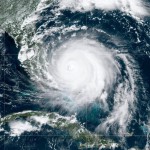
 From Wednesday, August 28th through Wednesday September 4th, our coast was on high alert. Hurricane Dorian roared to within 60 miles of the South Florida coastline, near Martin and Palm Beach Counties.
Early forecasts projected that the storm would crash into Palm Beach with Category 4 strength winds (maximum sustained at 130 to 156 mph). Destruction there would have been close to the catastrophic impact sustained in the Grand Bahamas.
Some forecasts showed a storm track crossing the Florida peninsula to get loose in the Gulf of Mexico. However, once Dorian stalled over the Bahamas, revised forecasts put it on a northern path aimed at Jacksonville. The combined “spaghetti ensembles” using both of the best “models”* closely correlated to a north/northwest track, changing to north/northeast once the upper level steering currents took effect.
Dorian’s stall was unprecedented – historic. Even so, it allowed the storm intensity to wane as it churned up cooler subsurface waters. When the upper level (+18,000 to 20,000’) currents started to coax the storm north, it was downgraded from a Category 5 showcasing a crisp and tight eyewall (over the Bahamas) to a Category 3 with a ragged-edged center and a wobbly track.
Then what happened? Dorian interacted with the Gulf Stream.
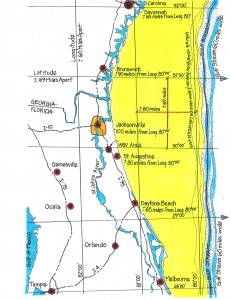
It is important to understand that although the approximately 60 mile wide Gulf Stream contains warm surface and deep waters moving northward at up to 5.6 miles per hour, the Stream itself is not a steering mechanism for a storm.
Dorian’s ragged eye and disturbed center was able to gather over the Gulf Stream and regain its core characteristics as it fed off of the warmer, deep waters. As it continued to gather itself, it began to track along with the Stream, steered by the upper level currents. Note : I learned this from the First Coast News Meteorologist, Tim Deegan.
That dynamic proved to be great news for our area. You can see from the diagram that the western edge of the Gulf Stream is 80 to 100 or more miles east of our coastline. That creates a sort of natural buffer. Additionally, we are further sheltered by being the westernmost community on the eastern seaboard.
Storms that track along the Gulf Stream have their maximum energy fields out to the northeast and east, over the open ocean. Because of this aspect, it is always better to be on the west side of a hurricane, as it moves north.
read more +
 Did you know that St. Johns County farmers are Florida’s most productive potato growers? In fact, St. Johns County is the #7 producer of potatoes in the nation. St. Johns County potatoes have anchored products by Frito-Lay, Cape Cod, Kettle, Snyder’s and others. Do you know how potatoes took root in the County?
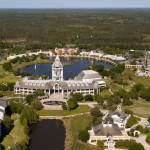 As our national and local economy remains robust, we can expect many more commercial, retail, office, personal service, dining, and entertainment options to blossom and complement our community.
 Twenty-two years ago, in the Spring of 1997, I moved my family to North Florida. We started our family in Boca Raton, Florida, then moved to Laguna Beach, California. Prior to the Centennial Olympic Games, we relocated to the Buckhead community in Atlanta, Georgia. After the Games, we decamped Atlanta for Ponte Vedra Beach. Once our children were literally off-and-running with their careers, we down-sized into one of Jacksonville’s historic neighborhoods, first platted in 1921.
 Falling Water at Bear Run is the internationally-acclaimed, magnum opus of America’s most famous architect, Frank Lloyd Wright (FLW). The house he designed in 1936 for Pittsburgh’s department-store magnates, Edgar J. and Liliane Kaufmann, was truly a labor-of-love on the part of both the architect and the clients.
 We live in a very mobile society. International travel for education and leisure is now commonplace. Travel, whether spur-of-the-moment short duration trips or well-planned group or individual extended excursions are becoming the norm for families and friends. People seem to gravitate, through curiosity and inquisitiveness, to the pursuit of new experiences. For many, the acquisition of these experiences is far more satisfying than being the beneficiary of gifts and material goods.






 facebook
 twitter
 youtube
 WGV blog